Monitoring Systems Detect Earthquake in the Lake District
Tri-Tech Surveyshas identified clear evidence of the mini earthquake that occurred late on Tuesday 3 December at approximately 23:23, affecting parts of Lancashire and the Lake District.
The seismic event, which was felt by residents across the region, was later confirmed and reported by the BBC, with people describing brief shaking and unusual noises inside buildings. The earthquake was classified as minor but noticeable, typical of low-magnitude seismic activity occasionally experienced in the UK.
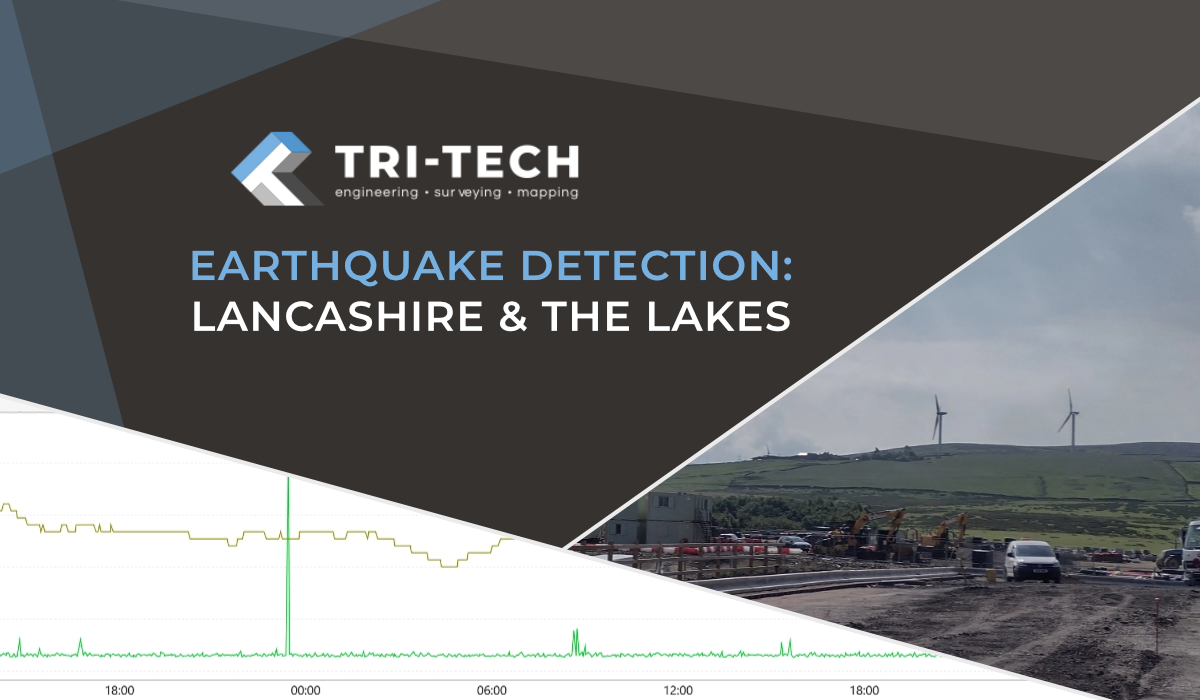
At the time of the event, a member of the Tri-Tech Surveys team was reviewing live monitoring data from a vibration and tilt monitoring system installed within a client’s building in the area. The system, which includes a vibrometer and tiltmeter, recorded a distinct and sudden response that aligns precisely with the reported time of the earthquake.
Analysis of the data shows a sharp, short-duration spike in Peak Particle Velocity (PPV) at 23:23 on 3 December, clearly standing out from normal background vibration levels. This spike is accompanied by a corresponding response within the tilt data, after a quick analysis of the tilt meter readings at that point in time we were able to remotely determine that no movement out of the ordinary had taken place as a result of the earthquake. This has since been backed up by manual readings on monitoring prisms using traditional methods.
Key observations include:
A sudden increase in vibration velocity recorded across the monitoring system.
The event occurring outside typical construction or traffic-related vibration patterns.
Clear differentiation from gradual temperature-related trends visible elsewhere in the dataset.
No sustained vibration or follow-on activity, consistent with a single, isolated seismic event
These characteristics strongly suggest that the monitoring equipment captured the ground motion caused by the earthquake itself.
The findings correlate closely with reports published by the BBC, which confirmed a small earthquake affecting Lancashire and the Lake District on the same evening. While the event posed no risk to structures, it was sufficiently strong to be felt indoors, making it a notable example of natural ground movement recorded by building monitoring equipment.
The Value of Monitoring Systems
Although Tri-Tech Surveys’ monitoring systems are typically installed to protect buildings during construction, infrastructure works, or other ground-influencing activities, this event highlights their broader capability. High-sensitivity vibration and tilt monitoring can provide reliable, time-stamped evidence of unexpected ground movement, including seismic events.
Tri-Tech Surveys is a specialist surveying and monitoring consultancy providing professional services across the UK. The company delivers vibration, tilt, crack, noise, and dust monitoring campaigns for a wide range of projects.
Each monitoring campaign is tailored to the specific requirements of the site, ensuring accurate data collection, compliance support, and clear reporting.
This event demonstrates the accuracy and reliability of Tri-Tech Surveys’ monitoring systems, as well as the expertise of its team in interpreting complex monitoring data.




 Leeds
Leeds Doncaster
 Sheffield
 Bradford
 Hull
Hull Halifax
 Sunderland
 Newcastle
 Middlesborough
 Yorkshire Moors
 Teesside
 Cumbria
 Harrogate
 Teesdale
 York
York Yorkshire Dales
 Northumberland
 Goole
Goole Carlisle
 Keswick
 Kendal
 Barrow-in-Furness
 Lancaster
 Blackpool
 Morecambe
 Southport
 Liverpool
 Wigan
Wigan Manchester
 Blackburn
 Burnley
 Forest of Bowland
 Oldham
 Chester
 Stockport
 Peak District
 Skipton
 Crewe
Crewe Rotherham
 Stoke
Stoke Driffield